
Too many ideas and no idea where to start? You don’t need more creativity, you need a process. Organizing your ideas comes down to five moves: capture everything, group what belongs together, rank what matters, structure it into a plan, and act on one next step.
This guide walks through each step with the techniques writing teachers and planners actually use, a worked example, and a quick guide to which method fits which kind of problem.
In this guide
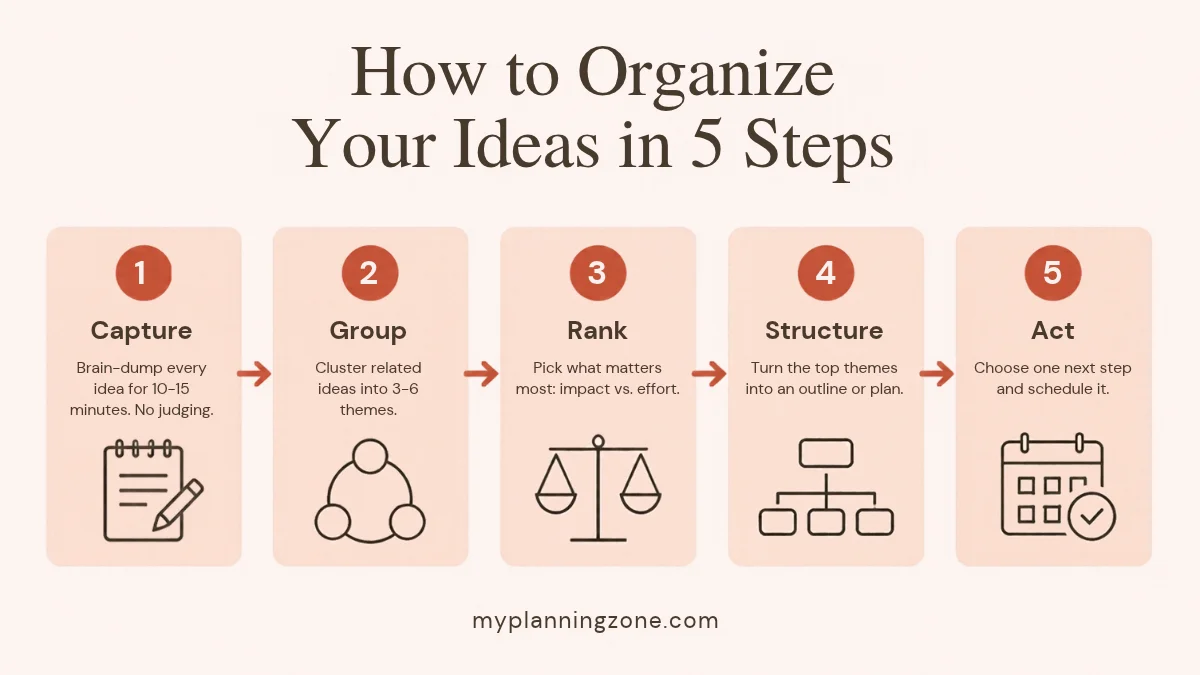
How to Organize Your Ideas in 5 Steps
Step 1: Capture Everything
You can’t organize ideas you haven’t written down. Set a timer and get every thought onto paper or a screen, without judging or sorting. Two techniques work well here:
- Brain dump: list every idea, task and question as bullet points.
- Freewriting: write continuously about the topic, even if it feels like nonsense. The UNC Writing Center describes it as letting your thoughts flow and writing down whatever comes to mind, without stopping.
Keep sessions short. The UNLV Writing Center suggests 10 to 15 minutes per brainstorming session so you don’t burn out.
Step 2: Group Related Ideas
Now look for patterns. Which ideas belong together? Aim for three to six themes. Two easy ways to do it:
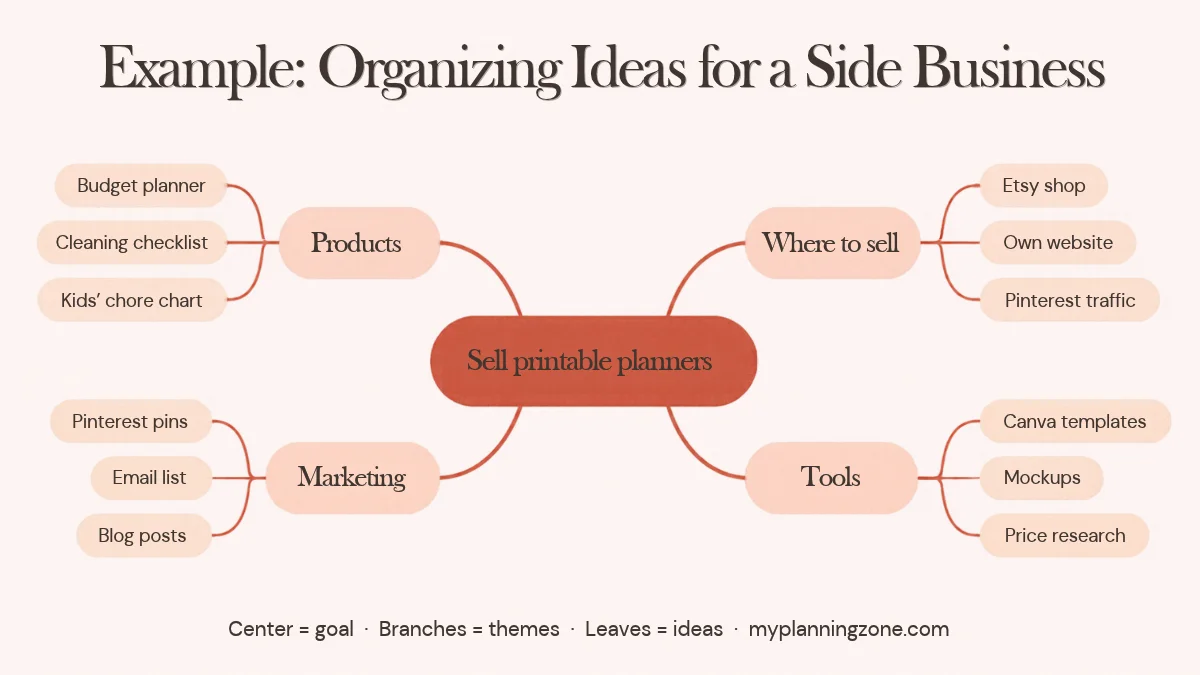
- Mind map (clustering): put your main goal in the center of a page and draw branches out to each theme, then smaller branches to individual ideas.
- Sticky notes: write one idea per note and physically move them into piles on a wall or table. This works especially well with a team.
Ideas that don’t fit anywhere go into a “parking lot” list. You’re not deleting them, just setting them aside.
Step 3: Rank What Matters
Not every idea deserves your time. For each theme, ask two questions: how much impact would this have, and how much effort would it take? Start with high-impact, low-effort ideas. If you’re ranking tasks rather than ideas, the ABCDE method or the Eisenhower Matrix in our guide on how to prioritize tasks work well.
Step 4: Turn It Into a Structure
Give your top ideas an order. For writing, that means an outline: main points as headings, supporting ideas underneath. For a project, it means a simple plan: phases, then tasks inside each phase. Start broad, then break each part into smaller pieces until every piece is clear.
Step 5: Act on One Next Step
Organized ideas are only useful if something happens next. Choose one concrete action, such as “draft the intro” or “research three competitors”, and put it on your calendar. Momentum from that first step makes the rest easier.
Worked Example: Organizing Ideas for a Side Business
Say you want to start selling printable planners and your head is full of half-formed ideas. Here’s the five-step process in practice:
| Step | What it looks like |
|---|---|
| Capture | A 15-minute brain dump: 30 ideas, from “budget planner” to “learn Pinterest” to “nicer logo” |
| Group | Four themes: products, where to sell, marketing, tools |
| Rank | High impact, low effort first: one product and one place to sell it. “Nicer logo” goes to the parking lot |
| Structure | Phase 1: create the first planner. Phase 2: open the shop. Phase 3: start marketing |
| Act | “Sketch the budget planner layout on Saturday morning”, added to the calendar |
Which Method Should You Use?
| Method | Best for | Tools |
|---|---|---|
| Brain dump | A crowded head, too many tasks | Notebook, notes app |
| Freewriting | Getting unstuck on writing or a decision | Paper, timer |
| Mind map | Seeing connections between ideas | Paper, whiteboard, mind-mapping app |
| Sticky notes | Group brainstorms, ideas you’ll rearrange a lot | Sticky notes, wall or table |
| Outline | Essays, articles, presentations | Word processor, notebook |
| Idea tracker | Ideas that come up over weeks or months | Printable tracker, spreadsheet |

Organizing Ideas for Writing
Writing is where messy ideas hurt the most. A reliable sequence: freewrite to find what you want to say, map the ideas to see how they connect, then turn the map into an outline before drafting. Label each branch of your mind map with the section it belongs to (introduction, point one, point two, conclusion), and the outline almost writes itself.
When You Feel Stuck
- Talk it out. Explain your idea out loud to a friend or record a voice note. Gaps become obvious when you have to say them.
- Change your setting. A walk or a different room often loosens things up.
- Shrink the goal. Instead of “organize my business plan”, aim for “group my marketing ideas”.
- Accept a messy start. Brainstorming isn’t supposed to look organized. The order comes later.
If ideas keep piling up between sessions, give them a permanent home. Our Printable Ideas Tracker lets you capture, categorize and prioritize ideas on one page, and the Printable Brain Dump Planner is made for Step 1.
Organize Your Ideas: FAQs
How do I organize my ideas?
Use five steps: capture every idea in a quick brain dump, group related ideas into a few themes, rank them by impact and effort, turn the best ones into an outline or plan, and schedule one next action.
What is the best way to organize thoughts on paper?
Start with a 10 to 15 minute brain dump or freewrite, then draw a simple mind map with your main goal in the center and themes as branches. Turn the strongest branches into a numbered outline.
How do I organize my ideas for an essay?
Freewrite to find your main point, map related ideas around it, label each branch with the section it belongs to, then turn the map into an outline before you start drafting.
What is a mind map?
A mind map is a diagram with your main topic in the center and related ideas branching out from it. It helps you see connections between ideas and group them into themes.
How do I keep track of ideas over time?
Give ideas one permanent home, such as a notebook section, a notes app or a printable idea tracker, and review it weekly to decide which ideas to act on, park or drop.
Final Thoughts
Organizing ideas isn’t a talent, it’s a sequence: capture, group, rank, structure, act. Try it on whatever is crowding your head right now. Fifteen minutes with a timer and a blank page is enough to start.
Keep reading: how to remember tasks, how to plan your week and productivity hacks.


