

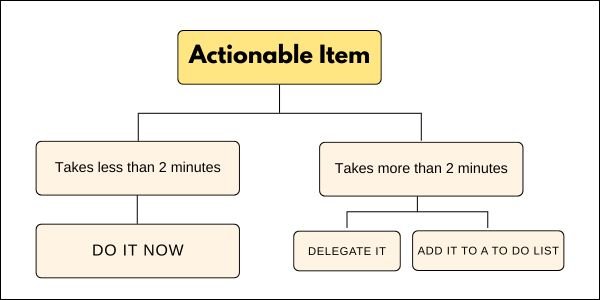
If a task takes less than two minutes, do it now.
That’s the 2-Minute Rule. Simple, but powerful. It’s a tactic for beating procrastination and building momentum. Popularized by productivity expert David Allen in Getting Things Done, and later expanded by James Clear in Atomic Habits, this rule is your shortcut to getting unstuck and getting started.
Table of Contents

What Is the 2-Minute Rule?
At its core, the 2-Minute Rule is about taking immediate action on small tasks and breaking big tasks into small starting points.
It works in two ways:
- If a task takes less than two minutes, do it now.
- Example: Replying to a quick email, filing a document, rinsing a dish.
- If a task is too big to finish now, spend two minutes starting it.
- Example: Want to read more? Read one page. Want to write? Type one sentence.
This rule removes the friction of “later” and replaces it with instant action.
Why It Works
We delay small tasks — answering emails, cleaning up, replying to messages — because they feel insignificant. But left undone, they build up, mentally and physically. The 2-Minute Rule stops that buildup early.
Pros:
- Kills procrastination: Immediate action prevents task accumulation.
- Builds momentum: Small wins create progress and motivation.
- Saves mental energy: You avoid overthinking tasks that could’ve been done already.
- Increases consistency: It helps form habits by focusing on starting, not perfection.
Cons:
- Can become a distraction: Constantly switching to small tasks can interrupt deep work.
- Risk of doing low-impact work: Not all quick tasks matter. Being “busy” isn’t the same as being productive.
- Overuse can lead to burnout: Saying yes to every small thing might drain focus and energy.
Use it wisely — don’t let it hijack your day. The 2-Minute Rule is best when applied with intention, not mindlessly.
Two Ways to Use It
1. Eliminate Small Tasks
If a task takes two minutes or less, don’t schedule it. Don’t add it to a to-do list. Just do it. Right now.
2. Start Big Habits
Want to build a long-term habit? Shrink it.
- Want to run daily? Put on your shoes.
- Want to read more? Open the book. Read one paragraph.
- Want to write every day? Write one sentence.
The idea isn’t to finish the whole habit — it’s to start. Two minutes gets you moving.
Examples of the 2-Minute Rule
Here’s how this looks in real life:
Personal Life
- Make your bed
- Take out the trash
- Refill your water bottle
- Put clothes in the hamper
Work & Productivity
- Reply to a quick email
- Rename and organize a file
- Add a task to your calendar
- Scan and upload a document
Habit-Building
- Do 10 pushups
- Read one paragraph
- Journal one sentence
- Open a language-learning app
These are small actions — but they add up fast.
Deep Work vs. 2-Minute Tasks
Here’s the catch: 2-minute tasks can conflict with deep work. If you jump to every small task immediately, you can destroy your focus.
Deep Work = Long, focused, uninterrupted effort
Think: Writing a report, solving a hard problem, coding, designing.
2-Minute Tasks = Fast, lightweight, low-effort actions
Think: Email replies, calendar updates, filing, small cleanups.
How to balance:
- Batch your 2-minute tasks before or after deep work blocks.
- Silence notifications to protect your deep focus time.
- Use a brain dump: When a quick task pops into your head, write it down. Handle it later.
The 2-Minute Rule is a tool — not a to-do list dictator. Use it to clear the path before deep work, not during it.
What Happened When I Used the 2-Minute Rule
Here’s what changed when I applied the 2-Minute Rule consistently for 30 days:
- Inbox down to zero: I stopped postponing replies. Anything quick got handled on the spot. No backlog.
- My space got cleaner: I’d see a mess — desk, dishes, bags — and reset it in under 2 minutes. No clutter. No chaos.
- Better focus during deep work: With small tasks cleared out early, I wasn’t distracted mid-project by mental reminders like “text this person” or “file that document.”
- Stronger habits: I started reading daily again. Just two minutes at first — but I rarely stopped at two. Starting made continuing easier.
It didn’t overhaul my life overnight. But it created momentum — and that momentum made everything else easier.

FAQ’s
What is the 2-minute habit rule?
The 2-minute habit rule is a strategy for making habits easier to start. Instead of trying to build a big habit all at once, you scale it down to a version that takes two minutes or less. For example, “read for 30 minutes” becomes “read one page.” It lowers resistance and helps you build consistency.
What is the 2-minute strategy?
The 2-minute strategy has two parts:
– If a task takes less than two minutes, do it now.
– If a task is big, start with just two minutes of it.
This helps clear small tasks quickly and break the inertia of starting larger goals.
What is the 2-minute hate in 1984?
The Two Minutes Hate is a daily ritual in George Orwell’s novel 1984. During it, citizens of Oceania are required to watch propaganda films and express rage at the regime’s enemies. It’s used to manipulate emotions and enforce loyalty to the Party. It’s not related to the productivity-focused 2-Minute Rule.
What is the 2-minute worry rule?
The 2-minute worry rule is a mental technique: if something is bothering you, give yourself two minutes to think about it — then move on. It helps contain overthinking and reduces anxiety by setting a time limit on unproductive worry.
Final Thought
The 2-Minute Rule isn’t about speed. It’s about starting. Whether you’re using it to crush tiny tasks or ignite major habits, it flips the switch from intention to action. And once you’re in motion, staying in motion gets a whole lot easier.
Related Articles
How to Master Timeboxing: The Productivity Technique That Actually Works