

If your to-do list is overflowing but your progress is stalled, you’re not alone. The modern workday is full of distractions, interruptions, and low-priority tasks that feel urgent. The ABCDE Method is a time-tested system designed to fix that.
Created by productivity expert Brian Tracy, the ABCDE Method forces you to prioritize with ruthless clarity. It’s not about doing more—it’s about doing what matters most.
Table of Contents

What Is the ABCDE Method?
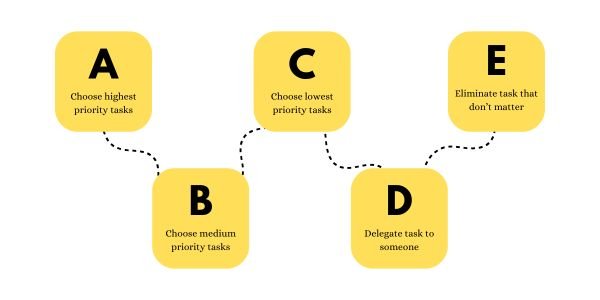
The ABCDE Method is a decision-making framework that helps you organize tasks by their importance and urgency. Each task on your list is labeled with a letter:
- A = Must Do. These are the high-stakes tasks. If you don’t do them, there are serious consequences—missed deadlines, lost opportunities, or big problems.
- B = Should Do. These are important, but not urgent. If you skip them, there are mild consequences—delays, minor setbacks, or someone being disappointed.
- C = Nice to Do. These tasks are pleasant but have no real impact. Think casual emails, chatting with coworkers, or organizing your desk.
- D = Delegate. These are tasks that need to be done—but not by you. Pass them on to someone else who’s capable.
- E = Eliminate. These are tasks that add no value at all. They waste time and energy. Cut them.
Simple? Yes. But it cuts through decision fatigue like a knife.
Who Is the ABCDE Method For?
The ABCDE Method isn’t just for CEOs or productivity geeks. It works for anyone who juggles responsibilities and wants more control over their time:
- Entrepreneurs who need to focus on what drives growth.
- Freelancers who wear multiple hats and must self-manage.
- Students managing coursework, jobs, and social lives.
- Managers and team leads who need to prioritize and delegate.
- Busy parents balancing work, family, and personal goals.
If you’re overwhelmed by competing demands, this method helps you regain control and stay focused.
Benefits of Implementing the ABCDE Method
The ABCDE Method stands out because it’s not complicated—and that’s the point. Here’s why it works:
– Simplicity
No apps, no complex systems. Just a pen, paper (or digital list), and a simple five-letter framework. It takes minutes to learn and seconds to apply, making it ideal for busy schedules and overloaded minds.
– Enhanced Focus
By forcing you to choose what really matters, the method eliminates the clutter. You stop spinning your wheels on low-impact tasks and start putting your energy into work that drives results.
– Easy to Communicate
Whether you’re a team lead assigning tasks or a freelancer managing client priorities, the ABCDE system is easy to explain and understand. Everyone knows what an “A” task means, and that clarity keeps everyone aligned.
– Discourages Procrastination
Because it ranks tasks by urgency and consequence, it’s harder to justify skipping the important stuff. When you label something as A-1, you’ve already told yourself: “This gets done first. No excuses.”
How to Implement the ABCDE Method
The ABCDE Method is powerful because it creates structure around your daily chaos. But to get real results, you need to apply it the right way. Here’s a clear, step-by-step guide to making it work in your daily routine:
Step 1: List Every Task You Need to Do
Start by getting everything out of your head. Open a notebook, planner, or digital tool (like Notion, Todoist, or Google Docs) and write down every task you’re planning to do today—or this week.
Don’t try to organize yet. Just brain-dump.
Example:
- Finish client proposal
- Check emails
- Call the dentist
- Prepare slides for team meeting
- Post on social media
- Review analytics
- Pay internet bill
- Order office supplies
Step 2: Assign a Letter to Each Task (A, B, C, D, E)
Now go down your list and apply the ABCDE rating system:
- A = Must Do. These tasks have serious consequences if you don’t do them. Think missed deadlines, financial loss, or damaging relationships.
- B = Should Do. These are important, but not urgent. There might be mild consequences, like inconvenience or delay.
- C = Nice to Do. These bring no real consequences if skipped. They’re optional or social.
- D = Delegate. If someone else can do it just as well—or better—delegate it.
- E = Eliminate. These are distractions or busywork. They don’t add real value.
Example Breakdown:
- A: Finish client proposal
- B: Prepare slides for meeting
- C: Call the dentist
- D: Order office supplies (ask assistant)
- E: Check emails every 10 minutes (waste of focus)
Step 3: Prioritize Within Each Letter Category
Some days you’ll have multiple A-level tasks. That’s normal. But not all “A” tasks are equal. So now, rank them in order of priority using numbers: A-1, A-2, A-3, and so on.
Your A-1 task is the most important thing you must do today. No exceptions.
Example:
- A-1: Finish client proposal
- A-2: Review analytics before meeting
- A-3: Confirm project deadline with partner
This small move—ranking your priorities—prevents decision fatigue when it’s time to act.
Step 4: Start With A-1 and Don’t Move Until It’s Done
This is the critical step. You’ve planned—now it’s time to execute.
Begin with A-1 and focus on that one task only. Don’t check your phone. Don’t “just reply” to a quick email. Don’t start on A-2 until A-1 is done.
This single-task focus helps you build discipline and finish important work faster.
If a task is too big to complete in one go, break it into smaller parts and tackle the first chunk.
Step 5: Review and Update Daily
Priorities change. What was an A yesterday might become a B or D tomorrow. So at the end of each day, take five minutes to:
- Cross off completed tasks
- Re-rank unfinished items
- Add new tasks for tomorrow
- Reassign ABCDE values as needed
This daily reset keeps your workflow aligned with what matters most, now.
Optional: Combine With Time Blocking
To level up, block out time on your calendar specifically for your A-1 task. Protect that block like a meeting with your most important client.
This ensures high-priority tasks get real attention, not leftovers.
FAQ’s
What is the ABCDE method?
The ABCDE Method is a time management and prioritization technique created by productivity expert Brian Tracy. It helps you sort tasks based on their importance and consequences using five categories:
A = Must do
B = Should do
C = Nice to do
D = Delegate
E = Eliminate
The goal is to focus first on tasks with the highest value and impact, starting with your top A-level priority (A-1), and working down.
What is the ABCDE model theory?
The term “ABCDE Model” can refer to different frameworks depending on the context, but in time management, it refers to the ABCDE Method developed by Brian Tracy. The “theory” behind it is simple: not all tasks are created equal. By ranking tasks according to their importance and urgency, you stop wasting time on low-impact activities and focus on what really moves the needle.
In other fields, like psychology or medicine, “ABCDE” may refer to other models, but in productivity, it’s all about task prioritization.
What is the ABCDE screening method?
The ABCDE screening method is unrelated to time management. It’s a medical guideline used to identify signs of melanoma or skin cancer by evaluating moles or skin lesions based on:
– A – Asymmetry
– B – Border irregularity
– C – Color variation
– D – Diameter over 6mm
– E – Evolving shape, size, or color
If you’re researching time management, ignore this version. It’s a totally different use of the same acronym in a medical context.
What are the steps in the ABCDE model?
Here are the core steps to applying the ABCDE Method for productivity:
List all your tasks. Write everything you need to do.
Assign each task a letter:
– A = Must do
– B = Should do
– C = Nice to do
– D = Delegate
– E = Eliminate
Rank your A tasks (A-1, A-2, etc.) by priority.
Start with A-1 and don’t move on until it’s done.
Review and repeat daily. Re-prioritize and adjust as needed.
This process helps you cut through overwhelm and work with focus and intention.

Final Word
The ABCDE Method works because it forces clarity. It removes the illusion of productivity and makes you confront what’s actually important.
You don’t need another app. You don’t need more hours in the day. You need to make better decisions with the time you already have—and that’s exactly what the ABCDE Method helps you do.
Try it today. Not someday. Today.
Related Articles
The 80/20 Rule: Work Smarter, Not Harder