

Time is your most valuable resource. But between constant notifications, multitasking, and burnout, staying focused feels harder than ever. That’s where the Pomodoro Technique comes in — a simple, no-nonsense method to help you get more done without grinding yourself into the ground.
Table of Contents

What Is the Pomodoro Technique?
The Pomodoro Technique is a time management method that breaks your workday into focused intervals (called “Pomodoros”) with short breaks in between. It’s structured, but flexible, and perfect for anyone who struggles with distractions or procrastination.
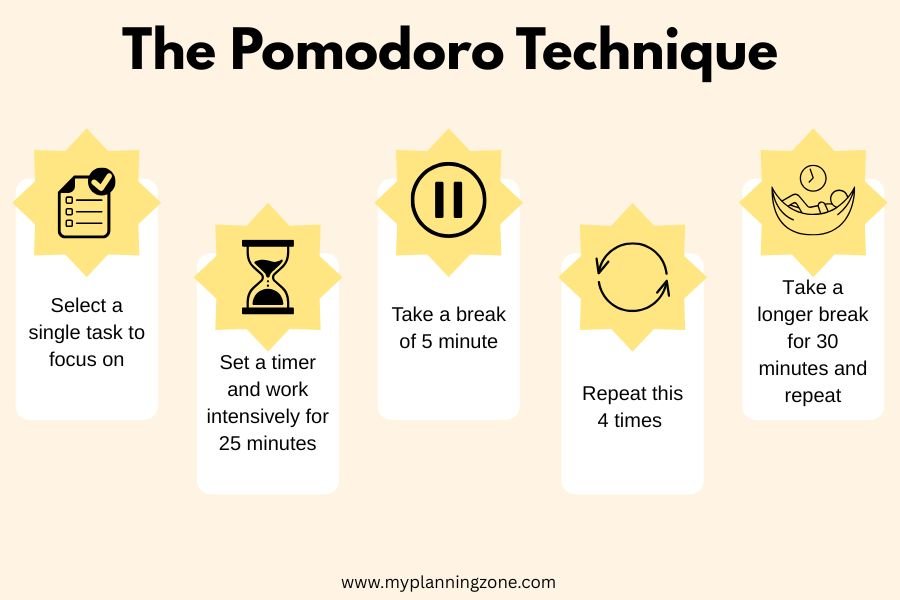
The core process looks like this:
- Pick a task.
- Set a timer for 25 minutes.
- Work on that task with full focus.
- Stop when the timer rings — take a 5-minute break.
- Every 4 Pomodoros, take a longer break (15–30 minutes).
It’s not about working harder. It’s about working smarter — with rhythm, energy, and clarity.
A Brief History of the Pomodoro Technique
The Pomodoro Technique was created in the late 1980s by Francesco Cirillo, a university student at the time. Struggling to focus and stay organized, Cirillo challenged himself to study in short bursts using a simple kitchen timer — shaped like a tomato (“pomodoro” in Italian).
What began as a personal productivity hack turned into a fully developed system that’s now used by millions worldwide. Cirillo eventually formalized the method in his 2006 book “The Pomodoro Technique,” promoting the idea that short, focused sprints can lead to deep work and lasting results, without burnout.
Why It Works
- Sharp focus: You know the timer is running, so you’re less tempted to scroll or drift.
- Bounded effort: 25 minutes feels doable. You’re more likely to start.
- Breaks prevent burnout: Frequent pauses help your brain reset.
- Visible progress: Every Pomodoro is a unit you can track and celebrate.
- Interruptions are managed: Distractions get written down, not followed.
Who Should Use It?
Anyone who:
- Struggles to focus or start tasks
- Works on long, open-ended projects
- Gets overwhelmed easily
- Wants a better structure without being micromanaged
It’s great for students, developers, creatives, remote workers, and anyone tired of feeling “busy” but getting nothing done.
Getting Started (and How to Master It)
Step 1: Set Up Your Environment
- Kill distractions: Turn off notifications, close unused tabs, and silence your phone.
- Get a timer: Use a physical timer, a phone app, or a Pomodoro-specific tool like Pomofocus or Focus Keeper.
- Choose your task: Be specific. “Write report intro” beats “Work on report.”
Step 2: Start with One Pomodoro
- Set the timer for 25 minutes.
- Work without interruption. If something pops into your mind — a text, a new task — write it down and return to your focus.
- When the timer rings, stop immediately — even if you’re in the flow.
Step 3: Take a Break
- Rest for 5 minutes. Get up. Stretch. Walk. Don’t check email or social media.
- After 4 Pomodoros, take a longer break — 15 to 30 minutes to recharge fully.
How to Use It Daily
- Plan your Pomodoros in the morning. Look at your to-do list and estimate how many Pomodoros each task will take. This turns vague plans into focused units of time.
- Batch similar tasks together (e.g., email, admin work) so you don’t waste a Pomodoro shifting focus.
- Keep a record. Use tally marks, a spreadsheet, or an app to track how many Pomodoros you complete. This builds momentum and reveals patterns in how you work.
- Adapt the system. Some people prefer 50/10 or 45/15. The technique is flexible — the principle is what matters: deep focus, short breaks, consistent cycles.
How to Master the Pomodoro Technique
- Protect your time. Let coworkers know when you’re in a Pomodoro — treat it like a meeting with yourself.
- Review weekly. How many Pomodoros did you complete? What distracted you? What took longer than expected? Use that data to improve.
- Pair it with deep work sessions. Use Pomodoros to dive into deep, high-impact work, not just small tasks.
- Stack your energy. Match Pomodoros to your energy levels. Do creative or high-focus work early; save admin tasks for later cycles.
- Keep it sustainable. If you’re exhausted, don’t push for “just one more.” This method is about working sustainably, not endlessly.
FAQ’s
What are the 5 steps in the Pomodoro Technique?
– Choose a task you want to focus on.
– Set a timer for 25 minutes (this is one Pomodoro).
– Work on the task until the timer rings — no distractions.
– Take a short 5-minute break.
– After every 4 Pomodoros, take a longer break (15–30 minutes).
Is the Pomodoro Technique actually good?
Yes — for many people, it’s highly effective. It boosts focus, reduces mental fatigue, and helps break large tasks into manageable pieces. Its built-in structure also makes it easier to start work, avoid distractions, and build momentum. While it might not suit everyone, it’s one of the simplest and most adaptable productivity methods out there.
Is Pomodoro good for ADHD?
Yes, the Pomodoro Technique can be especially helpful for people with ADHD. The short, timed intervals provide structure without being overwhelming, and the frequent breaks help manage attention and energy. It also builds a sense of urgency and completion, which can be motivating. Many people with ADHD use Pomodoro (or modified versions of it) as a key part of their focus toolkit.
Does Elon Musk use the Pomodoro Technique?
There’s no confirmed evidence that Elon Musk uses the Pomodoro Technique. However, he’s known for using time-blocking and 5-minute scheduling, which are similar in spirit — breaking time into strict units and assigning specific tasks to each. While it’s unclear if he uses Pomodoro specifically, he follows many of the same principles: intense focus, structured time, and tight control over his schedule.
Conclusion
The Pomodoro Technique is more than a time management trick — it’s a mindset shift. It teaches you to work with time, not against it. With just 25 minutes and a timer, you can stop procrastinating, stay focused, and actually finish what you start.
No fluff. No burnout. Just focused, intentional progress — one Pomodoro at a time.
Related Articles
The ABCDE Method: A Simple Tool to Stop Wasting Time